
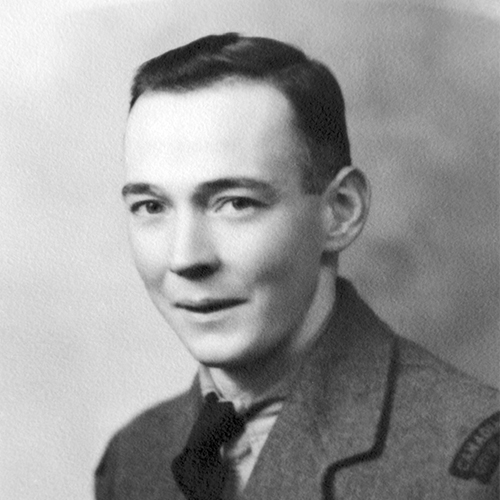
Galvin Burton
His farming story begins in 1880, when his grandfather, Joseph Burton purchased S.W. 12-16-17 W1. In 1881, Joseph married Eliza Burgess and together they had a family of four daughters and two sons. One of their sons was Noble Burton.
In 1888, due to continuous early frosts, Joseph moved his family from the Bethany area to N.E. 24-15-17, in hopes farming would be more successful. Joseph paid $505 for a quarter of land, not far from Franklin. After 30 years of frontier life and farming, Joseph sold his half section for $10,000 ($30/acre) to his son, Noble.
Noble and Stella raised a family of five, two daughters and three sons. Noble was a successful farmer for 40 years. In January 1942 at the age of 21, their son Galvin received his call to join the Army. When he returned from serving four and a half years in the Canadian Army during World War II, Galvin took over the family farm.
Galvin started in the Royal Canadian Fusiliers in Portage La Prairie, MB. It did not take long for the Army to discover that Galvin was mechanically inclined. He was switched over to the Royal Canadian Electrical and Mechanical Engineers and was posted to Seaforth Barracks at Burrard Inlet. Galvin was put to work in maintenance and general mechanic work. He also acted as a truck driver instructor. He took recruits over to Sea Island (now Richmond). Due to health reasons, Galvin missed his posting to Kiska, Alaska in the Aleutian Islands.
In due time his outfit was posted to Debert, Nova Scotia in preparation for going overseas. Galvin’s train ride went as far as Kitchener, Ontario where he was selected into a group and pulled off for a special assignment. Galvin worked to winterize vehicles, specifically track vehicles called “Weasels” for a month. The vehicles needed to be tested and evaluated for performance in extremely cold temperatures. Once he was done with the “Weasels”, Galvin was then posted to Debert and attached to another RCEME outfit. He was there for only a short amount of time before he was being outfitted for overseas. He travelled on the “Mauritania”. The Mauritania sailed solo with no convoy- they would have to keep a zig zag course for sub protection.
After seven days at sea, they docked in Liverpool on Christmas Eve 1943. Galvin was stationed at a camp called “Warrens Park”. This was the 1st Canadian Air Base workshop where he worked on all kinds of vehicles.
When the war was over Galvin was sent to Belgium and Holland to bring back army trucks to Warrens Park for servicing. Galvin was shipped home either on the Queen Mary or Queen Elizabeth, he couldn’t recall. He was at sea for four days and then he was docked at New York Harbor, where he had the opportunity to see the Statue of Liberty!
On March 29,1946, he was discharged from the army in Winnipeg and headed for home. Five days later, while still wearing his uniform, Galvin was best man for his brother Ormond’s wedding.
Galvin immersed himself back into the life he so missed, farming. Galvin worked with his two brothers, Hector and Ormand, picking a never-ending mountain of stones in the fields. Before he knew it, he was promoted to seeding the crops with a 28-run drill. The following spring he took over the farm from his father, Noble.
Hector was also a successful farmer in the community, farming by himself until the 1970’s. Hector and his son Wayne then incorporated into HEC-WAY Farms. They offered custom grain hauling to surrounding farmers. Hector and Wayne built themselves a fully automated grain storage system at the farm. It was one of the first in the area and allowed the farm to store roughly 125,000 bushels of grain.
His brother Ormand and his wife also successfully farmed south of Clanwilliam for 35 years. Thus, the legacy of farming was in the Burton family through and through. The Burton brothers all made an impact in their own way for their future generations who also chose to make agriculture their life’s work. Even though Galvin was the only Burton to serve in the Canadian Army, the Burton family as a whole made a significant contribution to agriculture history in Manitoba. The Burton family farm, like so many farms in Manitoba was where they all grew together, worked together, and lived together. Farming was in their blood and remains so to this day.
In 1946, a new teacher arrived to teach at the Cold Stream School near Franklin, MB. Her name was Sibyl Yerex, lucky enough it just so happened that she boarded at Noble and Stella’s place, Galvin’s parents. Galvin was a tall man and to this day, members of the community can point out a Burton by their stature and stride when they walk down Main Street. Galvin caught Sibyl’s attention at the SpringHill community dance, when he entered the hall and proceeded to hang his grey fedora on a hook high above the row of the hooks provided. He was certain his hat would still be there at the end of the night as no one else would be able to reach it. On July 16th, 1949, the hottest recorded day at the time, Sibyl Yerex found her teaching career abruptly end when she married Galvin and began her new chapter as a farmer’s wife. Galvin and Sibyl made a loving family of four, two sons (Blaine and Miles), and two daughters (Brenda and Myrna). Farming five quarters in that era brought hard times, as nothing came easy. Sibyl would do anything to provide financial aid. She started sewing and her skill continued to be handy as she sewed both her daughter’s graduation and wedding dresses.
Galvin genuinely cared for the outdoors, wildlife and the land. Galvin, as well as his brothers held private pilot licenses. It is worth noting that Hector’s wife Irene, also held her private pilot license and was one of the first group of women in Manitoba to do so. In 1957, Irene and Hector were charter members of the Manitoba Flying Farmers Association, and Irene also held the title of MBFF Queen within the group. The Burtons, along with many others, were part of the Manitoba’s Aerial Applicators Association, as it was primarily made up of the Flying Farmers group. Galvin was also a member of the Neepawa Rifle Club, volunteered as a wildlife observer and served as a snowplow operator for the Cold Stream District. His main interests were always nature and wildlife.
Galvin never completely retired. He took pride in his homestead and reduced his farm to an acre amount which he considered to be a “hobby farm”. He would also lend a hand to his in-laws the Abel family, into which his daughter Brenda married. To protect his love of nature, Galvin and Sibyl signed an agreement with the Manitoba Habitat Heritage Corporation that would permanently protect 88 acres of valuable habitat. This land is located along Stoney Creek, which is home to the world’s most southerly naturally reproducing brook trout populations. This accomplishment also complimented the Burton Family receiving the “Century Farm” title, for maintaining continuous agricultural production for more than 100 years.
Both of Galvin’s sons inherited his mechanical interests and passion for the land. Both remained curators of the land and farmed using multiple practices before their own passings. Galvin passed away suddenly on April 14th, 2002, at the age of 81. He still resided on the home farm. His daughter, Brenda, still farms one of the Burton quarters of land today.
Galvin Burton’s Medals:
Lifetime Legion Member since 1944
Canadian Volunteer Service Medal and Clasp
War Medal 1939-45
1939-45 Star